
Amendment 3 Passed: What It Changes for Florida Buyers
Florida voters approved Amendment 3 on November 3, with about 62% of the vote in unofficial results. It needed 60%. The changes start January 1, 2027, so your buyers will start asking questions now.
The short version: the Florida homestead exemption is about to get much bigger. An exemption takes a set dollar amount off the value your property taxes are based on. A bigger exemption means a smaller tax bill, and a smaller tax bill means a lower monthly housing cost.
That matters because buyers qualify based on their total monthly cost, and property taxes are part of it. Below are the numbers, a worked example, and the one rule that could trip up your out-of-state buyers. Results stay unofficial until certified.
The homestead exemption is rising
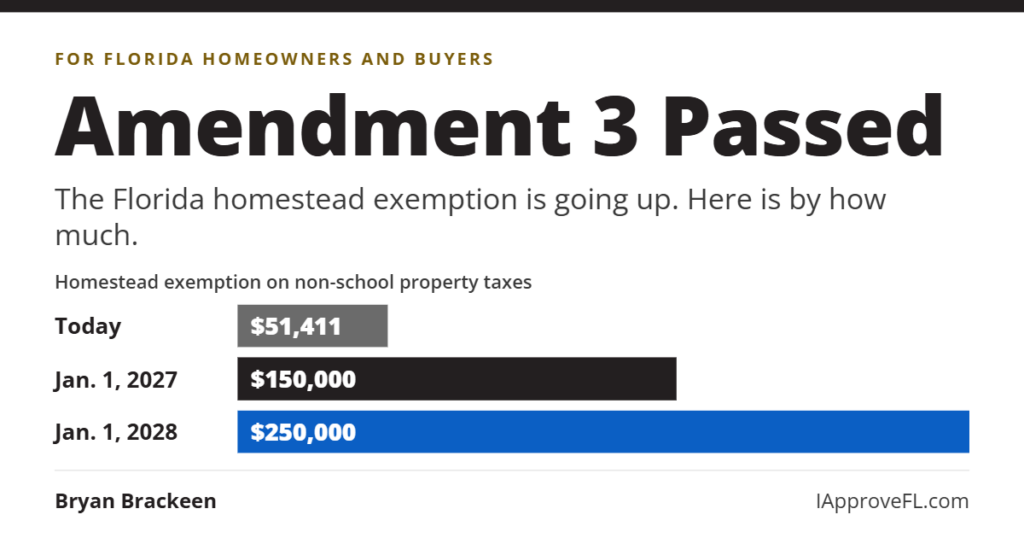
For taxes other than school taxes, the Florida homestead exemption goes from $51,411 today to $150,000 on January 1, 2027. On January 1, 2028, it goes to $250,000. After that, it adjusts for inflation.
Two things stay the same. School taxes are not affected, so homeowners will still get a tax bill. And Save Our Homes stays in place. That is the rule that limits how much a homestead’s taxable value can rise each year.
The exemption is a fixed dollar amount. It does not grow with the price of the home. So the savings are the same on a $700,000 home as on a $400,000 one, as long as the home is assessed above $250,000. Assessed value is the number the county uses to figure the tax bill. Homes assessed below $250,000 will save less in 2028.
What it looks like in St. Lucie County
Here is an illustrative example. It uses 2026 Port St. Lucie tax rates. Counties set tax rates in mills, and one mill is $1 of tax for every $1,000 of taxable value. The total here is 22.0043 mills, and about 6.2 of those are school tax. The home is worth $400,000 and is assessed at its purchase price. The example assumes no change in rates or values.
| Today | 2027 | 2028 | |
|---|---|---|---|
| Estimated annual tax | $7,835 | $6,282 | $4,706 |
| Annual savings | about $1,554 | about $3,130 | |
| Monthly savings | about $129 | about $261 |
Look at the 2028 column. On this home, the yearly bill drops by close to 40% from today. Savings vary by location, since each area sets its own rate, and those rates can change. So treat the table as estimated savings.
For an eligible buyer, a lower tax bill means a lower monthly payment. It also lowers their debt-to-income ratio, which compares monthly debts to monthly income. Lenders use that ratio to decide how much a buyer can borrow. Talk to a licensed mortgage loan officer about how a specific buyer’s numbers change.
The five-year rule for newcomers
The full exemption goes to people who were permanent Florida residents on December 31, 2026. Someone who becomes a resident after that date starts with the current exemption of $51,411. They move up to the full amount in the fifth year.
That date matters most for relocating buyers. A family that moves here in 2027 will not get the same break as a neighbor who has lived here for years. Their tax bill will be higher at first, and that can change how much home fits their budget.
Tell them early, before they build a price range around the full savings. Ask your loan officer to run a relocating buyer’s numbers with the smaller exemption. The buyer sees the real monthly cost up front, and you avoid a surprise after the contract is signed.
What it means for buyers and sellers
For buyers, Florida residents buying a new primary residence get the full exemption. Savings first show up on the November 2027 tax bills, not at closing. Second homes and rentals do not qualify, so those buyers should not plan around the new exemption.
For sellers, lower carrying costs are a real selling point for the next owner. Whether that shows up in the price is up to the market, so set expectations carefully. A seller who hears “your home is now worth more” may be disappointed. A seller who hears “your buyer’s tax bill will be lower” has a fair talking point.
If a buyer’s situation is not clear, reach out to a loan officer familiar with your market before you write the offer. A few minutes on the numbers early beats a rework later.
Investors, landlords, and what to watch
For property that is not a homestead, the yearly cap on assessment increases drops from 10% to 5%. That cap limits how much the taxable value can rise in one year. Property is still reassessed at full value after a sale or change of control, so the lower cap helps owners who hold, not buyers who just purchased.
The takeaway
The Florida homestead exemption jumps to $150,000 in 2027 and $250,000 in 2028 for people who were Florida residents by the end of 2026. Newcomers wait five years for the full amount. Savings show up on tax bills, not at closing. Run the numbers for each buyer before you promise anything.
FAQ
When does the bigger homestead exemption start?
January 1, 2027, with the next step on January 1, 2028.
Do school taxes go down too?
No. School taxes are not affected, so every homeowner still gets a tax bill.
Does it apply to second homes or rentals?
No. Those properties get a lower yearly cap on assessment increases instead.
Do buyers see the savings at closing?
No. The first tax bills with the new exemption go out in November 2027.
What if a buyer moves to Florida after 2026?
They start with the current exemption and reach the full amount in the fifth year.
Questions on how this affects a specific buyer or listing? Call Bryan at 316-734-6856.
Bryan Brackeen | NMLS #1530977 | CrossCountry Mortgage [CrossCountry Mortgage, LLC, 2160 Superior Avenue, Cleveland, OH 44114 NMLS3029 | RM.803095.000 All endorsements and testimonials are given without incentive or compensation.