Contract to Close: Where Deals Die and Which Ones Were Preventable
A signed contract feels like the finish line. It’s really the start of the part where most deals get hurt.
When deals fall through between contract and closing, it’s rarely one big surprise. Usually, something knowable was found late. The question for you as the Realtor is whether it could have been caught before the contract was signed.
Over the last two years, I’ve saved 10 deals that were headed for the cliff with another lender. Nine of them closed under the same loan program with me. That wasn’t luck. It came from knowing the guidelines well enough to see a path that wasn’t obvious from the file.
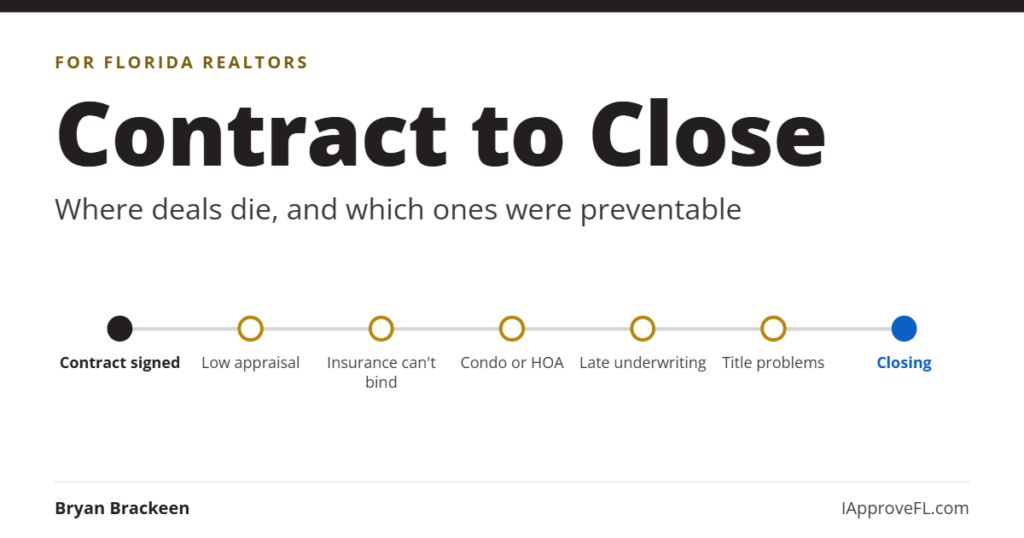
Here are the five places Florida deals die, and whether each one was preventable.
1. The appraisal comes in low (often preventable)
An appraisal is a licensed expert’s opinion of what the home is worth. The lender only lends against that number, even when the contract price is higher.
Here’s an illustrative example. A buyer puts 5% down on a $400,000 home. That’s $20,000 down and a $380,000 loan. The appraisal comes back at $380,000. Now the loan is based on $380,000, and 95% of that is $361,000. The buyer must bring $39,000 to close instead of $20,000. That’s $19,000 more, or the deal has to change.
What was preventable: The price. Offers built on recent closed sales, not asking prices, avoid most of these. If a gap still shows up, the usual fixes are a lower price, a split, more cash from the buyer, or a challenge to the appraisal using better comparable sales. Raise it with both sides early, not on deadline day, because every day of delay shrinks your options.
2. Homeowners insurance can’t be bound (often preventable)
In Florida, insurance can make or break a deal. “Binding” a policy means the insurance company agrees to cover the home, and the lender needs that proof before closing. Roof age, older wiring or plumbing, and wind protection features can limit who will write a policy, or what it costs. A buyer can be fully approved for the loan and still be unable to close.
What was preventable: Almost all of it. Quotes belong in the first few days after the contract, not the last week. Better yet, ask for the roof age and inspection history before the offer is written. A cost the buyer finds after the inspection period can kill the deal. Ask your loan officer to flag insurance-sensitive homes before the offer goes in, not after. Then the buyer knows the true monthly cost before they commit.
3. Condo or HOA problems surface late (preventable)
A condo loan depends on more than the buyer. The lender also looks at the building: its savings for repairs (called reserves), its insurance, any special assessments (extra fees charged to owners), and any lawsuits. Florida’s condo rules have tightened, and some buildings won’t qualify for certain financing at all. A buyer can fall in love with a unit, pay for an inspection, and then learn the building is the problem.
What was preventable: The surprise. Request the condo questionnaire, a form the building’s management fills out for the lender, and the budget right after the contract. Better still, screen the building before the buyer falls in love with the unit. Reach out to a loan officer familiar with your market to check a building before you show it. A five-minute check up front can save a buyer weeks of stress and save you a lost commission.
4. The file wasn’t fully reviewed, or the buyer’s money changed (preventable)
Two problems cause most late financing trouble. First, the lender only skimmed the file at pre-approval. Then underwriting, the final review where the lender checks every document, finds issues with no time left. Self-employment income, large deposits, and gaps in work history are common ones. Second, the buyer’s finances change after contract. A new car loan, a new credit card, a job change, or a big deposit with no paper trail can change what they qualify for.
What was preventable: Nearly all of it. A fully underwritten pre-approval means the lender reviewed the whole file before the offer, not after. And a buyer told on day one exactly what not to do usually doesn’t do it. Talk to a licensed mortgage loan officer before the offer about what a full review looks like, so the buyer hears the rules before the contract, not after.
5. Title problems and the ones nobody can prevent (partly preventable)
Title is the legal record of who owns the home. A title search can turn up liens (claims against the property for unpaid debt), open permits, or ownership questions. Many can be found early. Others only show up as closing nears, and the job then is to keep both sides calm while it gets cleared.
Some things can’t be prevented. A job loss, a death or divorce, a hurricane that damages the home, or an inspection that finds something serious can all end a deal. Even then, fast and honest communication can decide whether the deal is renegotiated or lost. The buyer and seller are far more willing to work with you when they hear bad news early and in plain words.
What was preventable: Whatever an early title search catches. The rest is about how quickly everyone talks.
The takeaway
Most deals don’t die at the closing table. They die weeks earlier, when a problem is found late that could have been found early. When deals fall through, the fix is usually the same: a fully underwritten pre-approval, insurance quotes right after contract, an early look at the condo or HOA, and clear instructions to the buyer.
FAQ
What is the most common reason a deal falls through after contract? Late discovery. Appraisal, insurance, and financing problems are usually knowable early but get found near the deadline.
Can a pre-approved buyer still lose the loan? Yes. A pre-approval is not a promise to lend. Changes in income, debt, or credit before closing can change the result.
When should insurance be quoted on a Florida purchase? Right after the contract is signed. If the roof or the home is older, quote it before the offer.
Can a deal that looks dead be saved? Sometimes. It depends on the file and the loan guidelines, and a loan officer who knows them can tell you quickly.
Call Bryan at 316-734-6856.
Bryan Brackeen | NMLS #1530977 | CrossCountry Mortgage [CrossCountry Mortgage, LLC, 2160 Superior Avenue, Cleveland, OH 44114 NMLS3029 | RM.803095.000 All endorsements and testimonials are given without incentive or compensation.]