
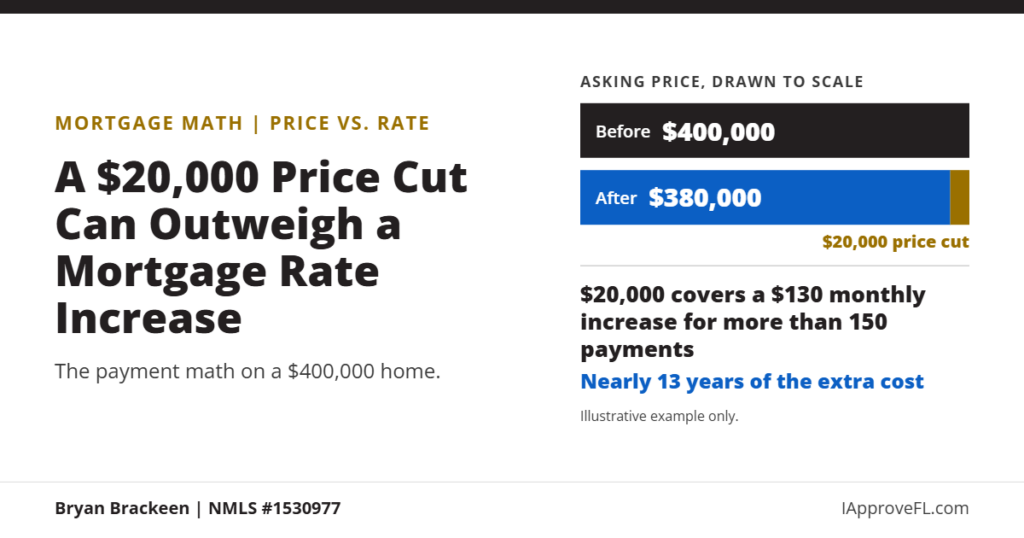
A $20,000 Price Cut Can Outweigh a Mortgage Rate Increase
Buyers keep saying mortgage rates are too high. Next to the last few years, they are. Next to the long-term average of 7.6%, today’s 7.1% looks a lot more normal.
Here is the short answer to the question behind it. Yes, a price cut can outweigh a mortgage rate increase. On a $400,000 home reduced to $380,000, the lower price can cover a higher payment for years.
This post walks through the math in plain words. You will see what a $20,000 price cut does to the payment, how long it can cover a higher payment, and a protection for first responders and transportation workers that works alongside it.
Why Do Buyers Focus on the Rate Instead of the Price?
Buyers focus on the rate because it is the number in every headline, while the price rarely makes the news. But a monthly mortgage payment depends on both.
The principal and interest payment is the part that pays back the loan and the cost of borrowing. Two things set it: how much you borrow and the rate you pay. Buyers see the rate move every week. They rarely notice what happens to the loan amount.
After several years of unusually low rates, today’s 7.1% can feel like a shock, even though it sits near the long-term average. Meanwhile, many sellers have lowered their asking prices. That drop is real money, and it shrinks the loan.
A buyer who only watches the rate sees half the picture. Give them the other half. Ask what monthly payment they are comfortable with, then compare homes by payment, not by price tag alone.
What Does a $20,000 Price Cut Do to a Mortgage Payment?
A $20,000 price cut on a $400,000 home lowers the loan by $19,000 and the payment by about 5%. That holds at any rate.
Here is the math. With 5% down, a $400,000 home means a $380,000 loan. Cut the price to $380,000 and the loan falls to $361,000. A payment is built from the loan amount, so a loan that is 5% smaller gives a payment that is about 5% smaller.
The savings do not stop there. The down payment shrinks by $1,000. Closing costs tied to the loan amount come down with it. And since property taxes are usually built off the purchase price, the yearly tax bill often drops too.
A buyer who skips a reduced listing because of the rate may be walking away from a bigger saving than the rate costs. Ask your loan officer to run the payment at both prices, so the numbers sit side by side.
Can a $20,000 Price Cut Cover a $130 Payment Increase?
Yes, and for a long time. At $130 a month, $20,000 covers more than 150 payments, which is nearly 13 years.
Suppose a higher rate adds $130 a month to the payment on this home. That sounds painful. But set it next to the $20,000 price drop. Think of that $20,000 as a cushion. Divide it by $130 and you get about 154 months of the extra cost.
That is a long runway. If rates come down during those years, the buyer can look at a refinance, which means replacing the loan with a new one. No one can promise that rates will fall or that a refinance will fit. It depends on rates, credit, and the home’s value at that time. But the buyer would have years to wait for that chance, and would already own the home.
This is an illustrative example, not a rate quote. Real numbers vary by loan and down payment.
How Does the Line of Duty Death Benefit Protect a Buyer’s Home?
It cancels up to $525,000 in eligible mortgage debt after a covered line-of-duty death, at no cost to the borrower.
CrossCountry Mortgage offers this through its Line of Duty Death Benefit program. It becomes part of the borrower’s loan. If a covered borrower owes $300,000 at the time of a covered death, that balance is cancelled. If the balance is higher, the benefit covers up to $525,000.
The program started with law enforcement, fire, and EMS. It now also covers eligible bus operators, railroad workers, airline workers including pilots and flight attendants, and eligible UPS and DHL workers. Not every death qualifies, and terms and exclusions apply. The borrower must still qualify for the loan.
Why does it fit here? A lower price helps a household afford the payment today. This benefit protects the family if the worst happens on the job. Talk to a licensed mortgage loan officer to confirm whether a buyer’s job and loan are eligible.
How Can Realtors Use the Price-and-Payment Math?
Put the payment and the price on one page, and let the numbers do the talking.
With buyers, stop comparing today’s payment to what someone paid two years ago. Compare the extra monthly cost to the price drop. A buyer who sees a $130 increase next to a $20,000 cut often feels very different about the same house.
With sellers, a price reduction is a payment reduction. That is what brings buyers back to the table. Frame a price change around the monthly payment, because that is the number buyers decide on. (Sellers should also consider other tools such as permanent and temporary buydowns).
With buyers in qualifying jobs, such as first responders, transit workers, flight crews, and delivery drivers, mention the Line of Duty Death Benefit. Ask what they do for work. Then reach out to a loan officer familiar with your market, and have them build the page for you.
The takeaway
A price cut and a mortgage rate increase pull in opposite directions. On a $400,000 home, a $20,000 cut shrinks the payment about 5% and can cover a $130 increase for nearly 13 years. Compare the payment, not just the rate.
FAQ
Can a lower price really offset a mortgage rate increase?
Often, yes. A 5% lower price means a payment about 5% lower. If the higher rate adds less than that, the price cut wins. A loan officer can run both.
Who qualifies for the Line of Duty Death Benefit?
Eligible law enforcement, fire, EMS, bus, rail, airline, UPS, and DHL workers. Terms and exclusions apply, and the borrower must still qualify for the loan.
What if rates come down later?
A buyer may look at a refinance, but no one can promise it will fit.
Want the numbers on a specific home, or want to know if your buyer qualifies for the Line of Duty Death Benefit? Call Bryan at 316-734-6856.
Bryan Brackeen | NMLS #1530977 | CrossCountry Mortgage [CrossCountry Mortgage, LLC, 2160 Superior Avenue, Cleveland, OH 44114 NMLS3029 | RM.803095.000 All endorsements and testimonials are given without incentive or compensation.]